01
A tooth is gone, or it's coming out, and there'll be a gap.
One implant can carry one crown in that space, standing in for the root as well as the part that shows.

Thoughtful treatments designed around your goals, comfort, and long-term oral health.
A dental implant is a small artificial root set into the jawbone, which then holds a replacement tooth. It is one way of dealing with a gap where a tooth has been lost — not the only way, and not right for everyone.
Call Now (520) 214-2484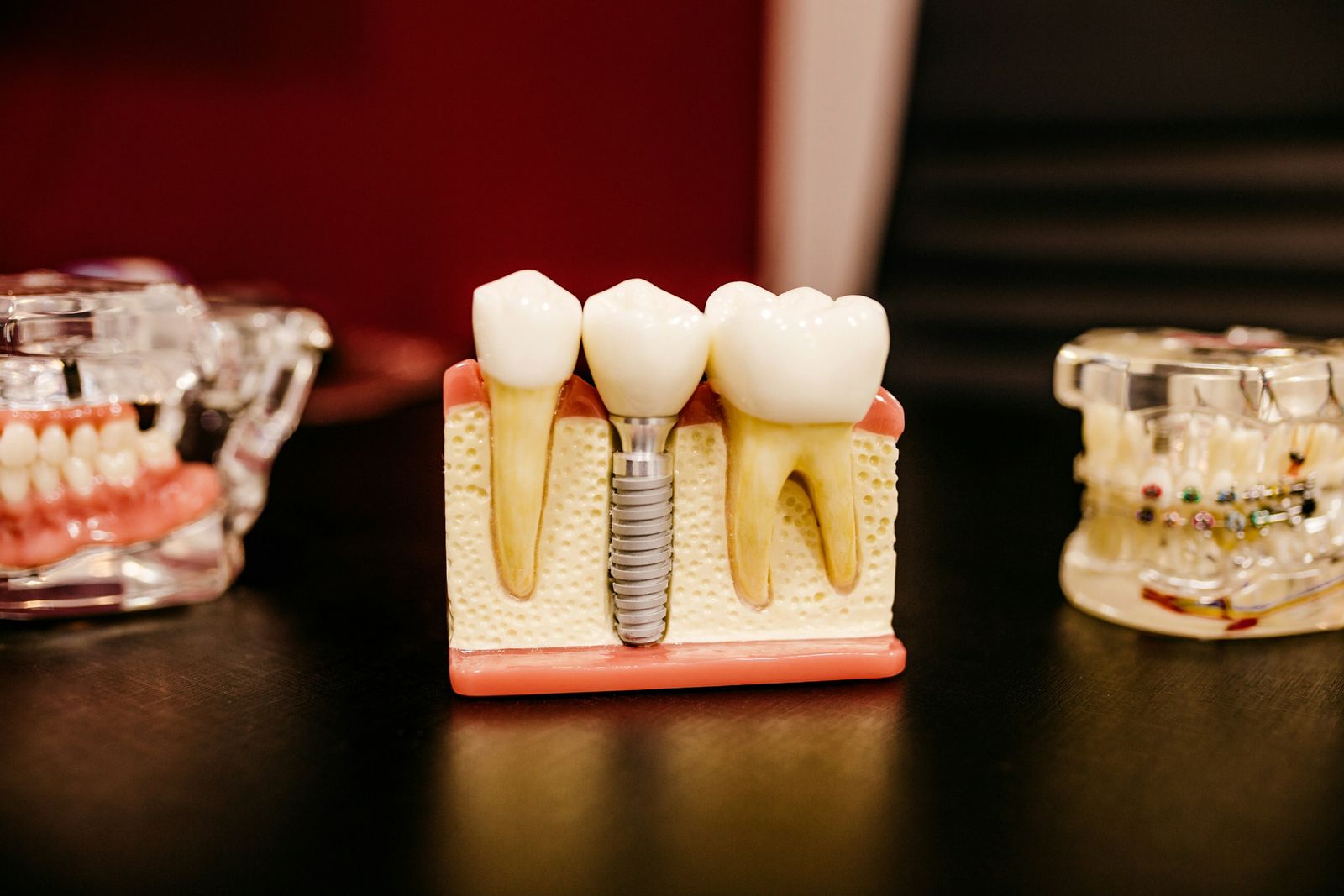
Is This You
Implants come up in a handful of fairly specific situations. These are the ones the treatment is usually being discussed for.
01
One implant can carry one crown in that space, standing in for the root as well as the part that shows.
02
Two implants can anchor a fixed bridge across a span like that, instead of a partial denture that comes in and out.
03
Implants can be used to hold a denture steady. Some designs clip on and still come out for cleaning; others stay fixed in the mouth.
04
Full-arch treatment puts a small number of implants at chosen points in the jaw to carry one restoration, rather than one implant for every missing tooth.
05
Bone and gum tissue have to be measured before anything is planned. Grafting exists for sites that have shrunk back, and narrower mini implants exist for tight spaces, but neither is a given.
06
Both affect how a site heals and how likely an implant is to be lost later, so suitability has to be assessed case by case rather than assumed.
The Options
Implant treatment is a category rather than a single procedure. These are the forms it takes, grouped by how many teeth are being replaced and by what sits on top of the implants. Which of them apply in any one case is a matter for assessment.
A connector called an abutment links the implant to the crown that sits on it. That crown goes on after the bone has grown around the implant, not before. Once it is in place, cleaning it is much like cleaning the tooth that was lost.
Where several teeth are missing in a row, a pair of implants can carry a fixed bridge across the gap. The false teeth in between are held by the bridge itself, so there is no implant under each one. Being fixed, it is not taken in and out the way a partial is.
Narrower than a standard implant, for sites without the bone or the room for one. They are less robust and do not go through the same integration process, so their use is confined to a narrow set of cases.
Implants placed at chosen points along the jaw — sometimes only four in one arch — holding a single fixed restoration. Its shape traces the arch of the jaw, so nothing has to sit across the palate.
A denture that clips onto attachments fitted to implants, and can still be taken out for cleaning. It holds more firmly than a denture resting on the gums alone, but it is still a removable appliance rather than a fixed one.
How It Goes
The order rarely changes, though the gap between the steps does. This is the general shape of implant treatment, not a timetable — healing sets the pace, and it varies from person to person.
Planning starts from health history, earlier dental trouble, and the amount of bone and gum tissue at the site. Some medical conditions call for clearance from a physician before treatment can be considered. Not everyone turns out to be a candidate.
This is the surgical part. Under local anaesthetic, the implant body is seated in the jawbone at the spot the root used to occupy.
Bone locks onto the implant before anything can be loaded onto it. That part cannot be hurried, and how long it takes differs from one case to the next.
Once the implant is stable, an abutment connects it to whatever sits on top — a crown, a bridge, or a denture attachment. Which of those it is comes down to the number of teeth being replaced.
Implants still need brushing, flossing and regular professional cleaning. Plaque left around one causes peri-implantitis, a gum infection that is the main reason implants are lost.

Before Anything Begins
The consultation comes first, whatever you are here about. It costs nothing and commits you to nothing.
The Money Part
The consultation is free and there is no obligation. You leave with the cost in writing before anything is booked, so the decision is yours to make away from the chair.
If a plan turns out not to be for you, that is a perfectly good outcome of a consultation.
Quick Questions
If yours isn’t here, the consultation is the place for it — or call and ask.
—of 05 open
It is anchored in bone rather than resting on the gum, which is a different arrangement from a removable denture. It is still an artificial tooth, though, and it does not feel identical to the one it replaced.
It is the name for bone growing onto the implant surface and holding it there. It is what allows an implant to take a bite force, and it is why the tooth that goes on top is normally fitted later rather than at placement.
Yes. The usual cause is peri-implantitis, an infection of the gum and bone around the implant driven by plaque. Smoking and a history of gum disease both raise the risk, which is why candidacy is assessed rather than assumed.
No. A bridge, a partial denture or a full denture each fill a gap in a different way, with different trade-offs. Which of them apply depends on the tooth, the bone underneath it, and the condition of the teeth either side.
Bone grafting and tissue grafting are the procedures used to build up a site that has shrunk after tooth loss or gum disease. They are not always possible, and the site has to be measured by a dentist before anyone can say either way.
Also At This Practice
No Cost, No Obligation
About an hour with Dr. Duaa. A scan, straight answers, and a written plan you take home.
Parking at the door. Nothing is treated on the day, and there is nothing to sign.