01
A filling keeps coming out of the same back tooth.
Fillings sit inside a tooth and need sound walls to hold on to. When too little of the tooth is left, a crown goes over what remains instead of inside it.

Thoughtful treatments designed around your goals, comfort, and long-term oral health.
A crown covers a tooth that has broken down too far for a filling to hold. A bridge closes the gap a missing tooth leaves behind, carried by the teeth or implants standing either side of it.
Call Now (520) 214-2484
Is This You
Crowns and bridges answer a fairly narrow set of problems. These are the ones that usually bring people to them.
01
Fillings sit inside a tooth and need sound walls to hold on to. When too little of the tooth is left, a crown goes over what remains instead of inside it.
02
A cracked or badly fractured tooth can keep splitting under chewing pressure. A crown holds what is left of the tooth together rather than leaving the crack to travel.
03
Root canal treatment hollows a tooth out, which leaves the walls brittle. A crown is the usual way of taking biting force off a tooth in that state.
04
Worn enamel does not come back. Crowns can rebuild the shape and height of teeth worn down that far, though the grinding itself needs looking at too, or the same force lands on the new crowns.
05
Teeth drift into an empty space over time, and the bite changes with them. A bridge fills that space, anchored to whatever sound teeth or implants sit at each end of it.
06
A bridge is fixed in the mouth and is not taken out at night. Whether one is possible depends on the health of the neighboring teeth, gums and bone, and not everyone is a candidate.
The Options
Which design suits a tooth depends on where it sits in the mouth, how much of it is left, and what it has to bite against. Each one gives something up.
A crownNot to scale
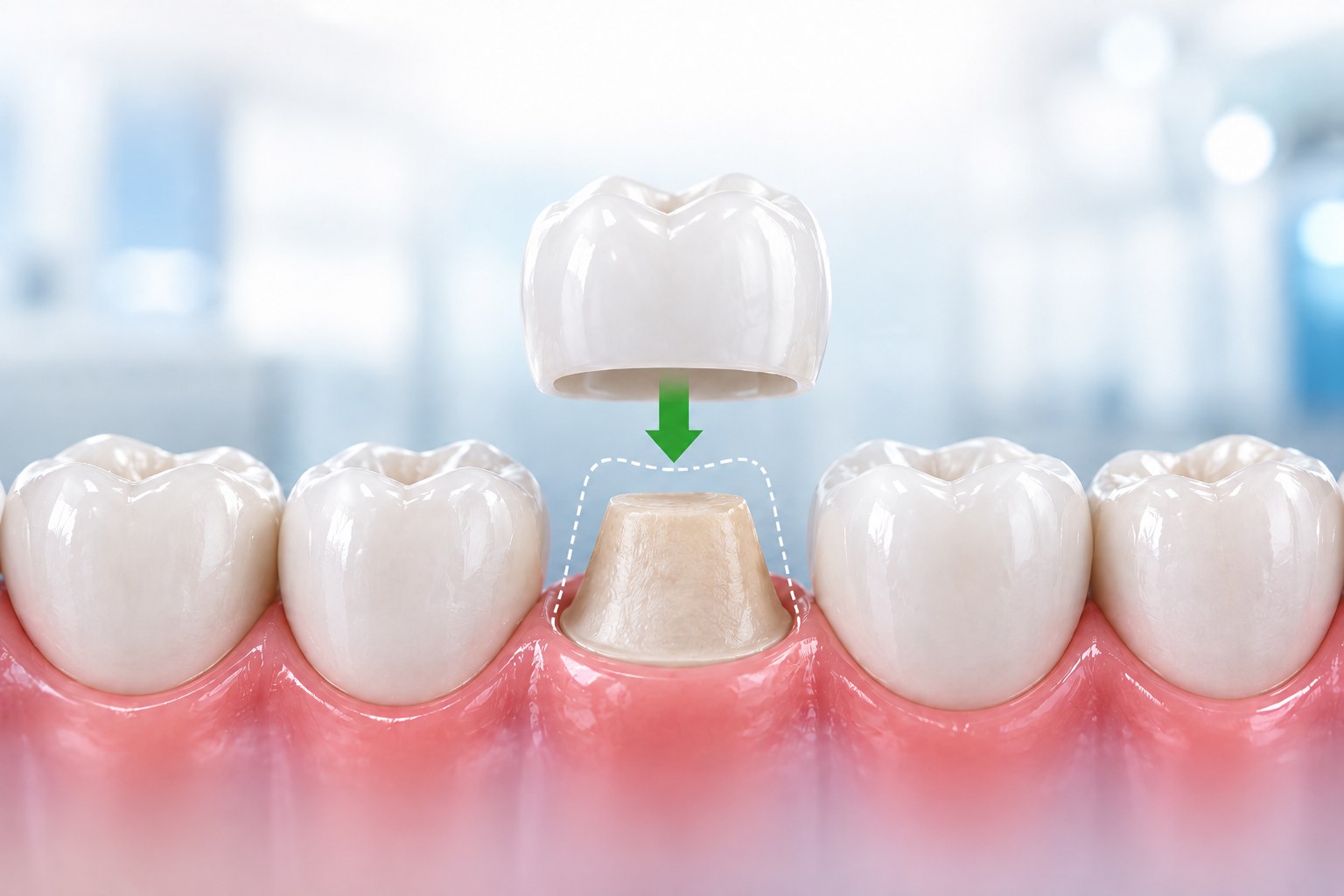
Metal-free crowns that form a shell around the whole tooth, down to the gum line. Ceramic is matched to the shade of the teeth beside it, which matters most at the front. Zirconia is the harder of the two and is used where the chewing load is heaviest, and the two look much alike. Either can sit over a natural tooth or an implant.
Two older approaches, both involving metal. A crown of porcelain fused to metal has a metal core with porcelain baked over the outside, and the porcelain can chip away from that core, which heavy grinding makes likelier. A gold crown has no porcelain to chip and can be shaped very closely to the tooth, but it looks like metal, which is why it is usually kept to back teeth that don't show.
Acrylic resin or stainless steel covers, worn while the finished restoration is being made to fit the prepared tooth. They keep the tooth covered and take the edge off sensitivity, but they are not built to last and are not intended to be worn long term by adults. In children, a steel crown is sometimes left on a damaged tooth until the mouth has finished developing.
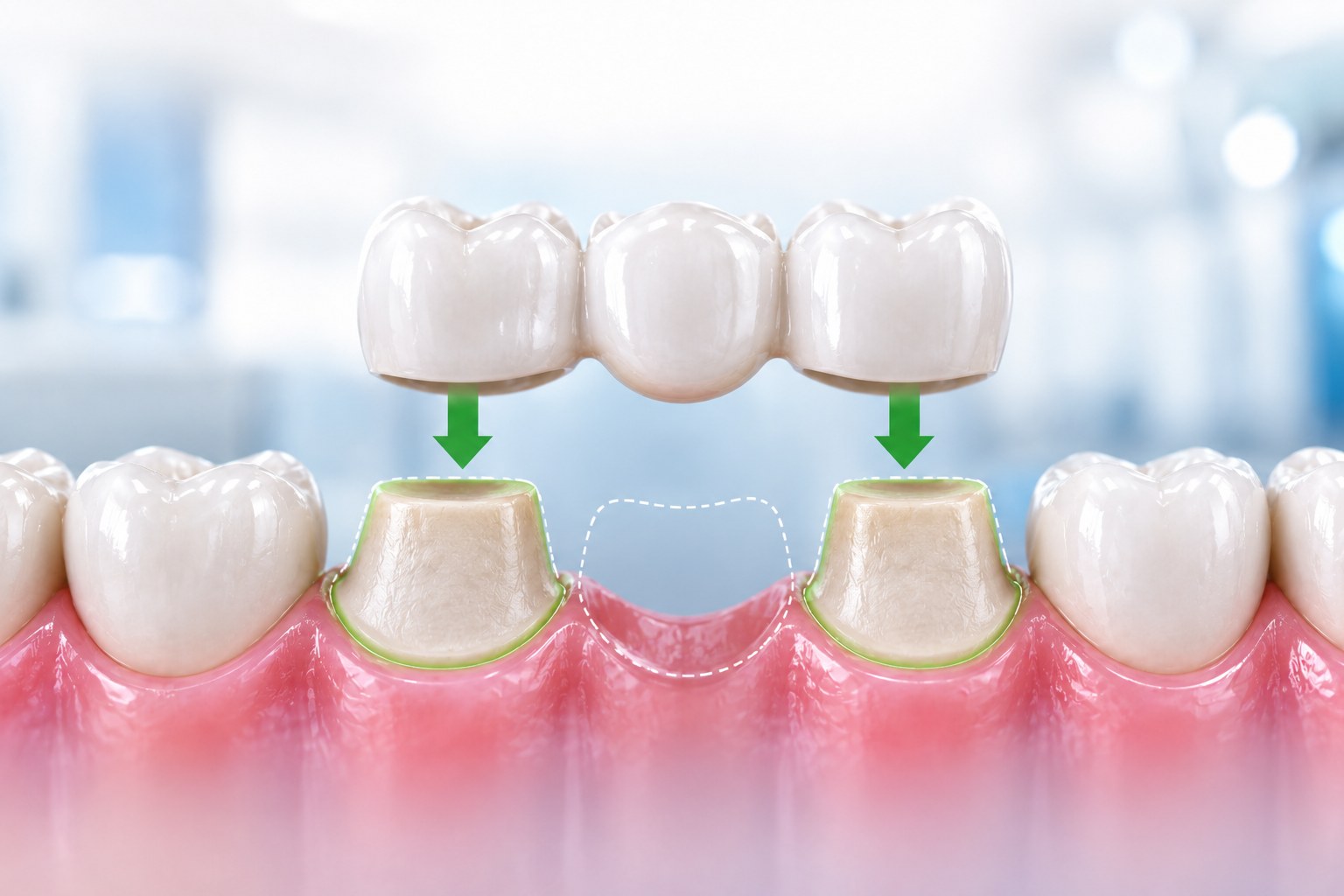
A row of crowns joined side by side: a crown at each end sitting over a prepared tooth, with a false tooth suspended between them. The trade-off is that the teeth at either end have to be reshaped to take those crowns, whether or not they needed work themselves. Where those teeth already need crowning anyway, that is less of a loss.
A false tooth with thin wings that bond behind the teeth on each side of the gap. Because those teeth are not cut down, it is the more conservative design. The bond is all that holds it, though, and most dentists treat it as a shorter-term answer rather than a lasting one.
Rather than resting on natural teeth, the bridge is fixed to implants placed in the jaw, usually one at each end, so nothing has to be done to the teeth beside the gap. It is the longer route: implants need surgery, enough bone to sit in, and time to fuse before anything is attached to them. Not everyone is suitable.
How It Goes
A crown or a bridge is made to fit one particular tooth in one particular mouth, so this kind of work comes in stages. How many stages, and how far apart they fall, depends on the tooth and on what else is being done to it.
How much sound tooth is left, and the state of the gum and bone around it, decide whether a crown is the right answer at all. Not every gap suits a bridge either. Sometimes the honest answer is a different treatment altogether.
Preparation means reducing a tooth in size under local anesthetic, so a crown can sit over what is left rather than inside it. For a bridge, the tooth at each end of the gap is shaped the same way. Some tenderness afterwards is ordinary, how long it lasts differs from person to person, and an ordinary painkiller is usually what it is managed with. Where root canal treatment is happening on the same tooth, preparation is often folded into it.
A finished crown or bridge is built to fit one specific prepared tooth, and building it takes time. A temporary cover keeps that tooth protected and dulls sensitivity while the work is made. Temporaries are designed to come off easily, so they take a little care.
Fitting means taking the temporary off, trying the finished piece in, and checking the fit, the shade and the bite before anything is cemented. Adjustment at that stage is ordinary rather than a sign something has gone wrong. A crown left sitting high against the opposing teeth is meant to be adjusted, not put up with.
A crown or bridge carried by implants is only attached once the implant has fused with the bone. That healing takes time and varies from person to person. It is something a dentist assesses rather than assumes.

Before Anything Begins
The consultation comes first, whatever you are here about. It costs nothing and commits you to nothing.
The Money Part
The consultation is free and there is no obligation. You leave with the cost in writing before anything is booked, so the decision is yours to make away from the chair.
If a plan turns out not to be for you, that is a perfectly good outcome of a consultation.
Quick Questions
If yours isn’t here, the consultation is the place for it — or call and ask.
—of 05 open
The crown itself cannot decay. The tooth underneath it can, along the margin where the crown meets the gum, and plaque left sitting there is what weakens it. The edge of a crown needs the same brushing and flossing as any other tooth surface.
It is a common worry, and it runs the other way round. What undermines a restoration is plaque left at the margins, not floss. Floss is curved into a C against the side of the crown and taken gently under the gum. With a bridge, the space beneath the false tooth has to be cleaned as well, and a water flosser is one way of reaching it.
Sometimes. A cantilever bridge hangs the false tooth off support at one end only, which asks a lot of a single tooth: it has to be sound and have enough bone under it. It is used far less often than the other designs, mainly where an implant is not an option. A dentist would need to assess whether that one tooth can carry it.
It is worth raising before a material is chosen. Grinding loads a restoration the same way it loads a natural tooth, and porcelain can chip under it. A guard worn at night is the usual way of taking that force off.
No. A bridge is fixed to the teeth or implants either side of the gap and stays in the mouth. A partial denture is removable and comes out to be cleaned. Which of the two is possible depends on how many teeth are missing and what is left to anchor to.
Also At This Practice
No Cost, No Obligation
About an hour with Dr. Duaa. A scan, straight answers, and a written plan you take home.

Parking at the door. Nothing is treated on the day, and there is nothing to sign.